Provenance:
European Private Collection
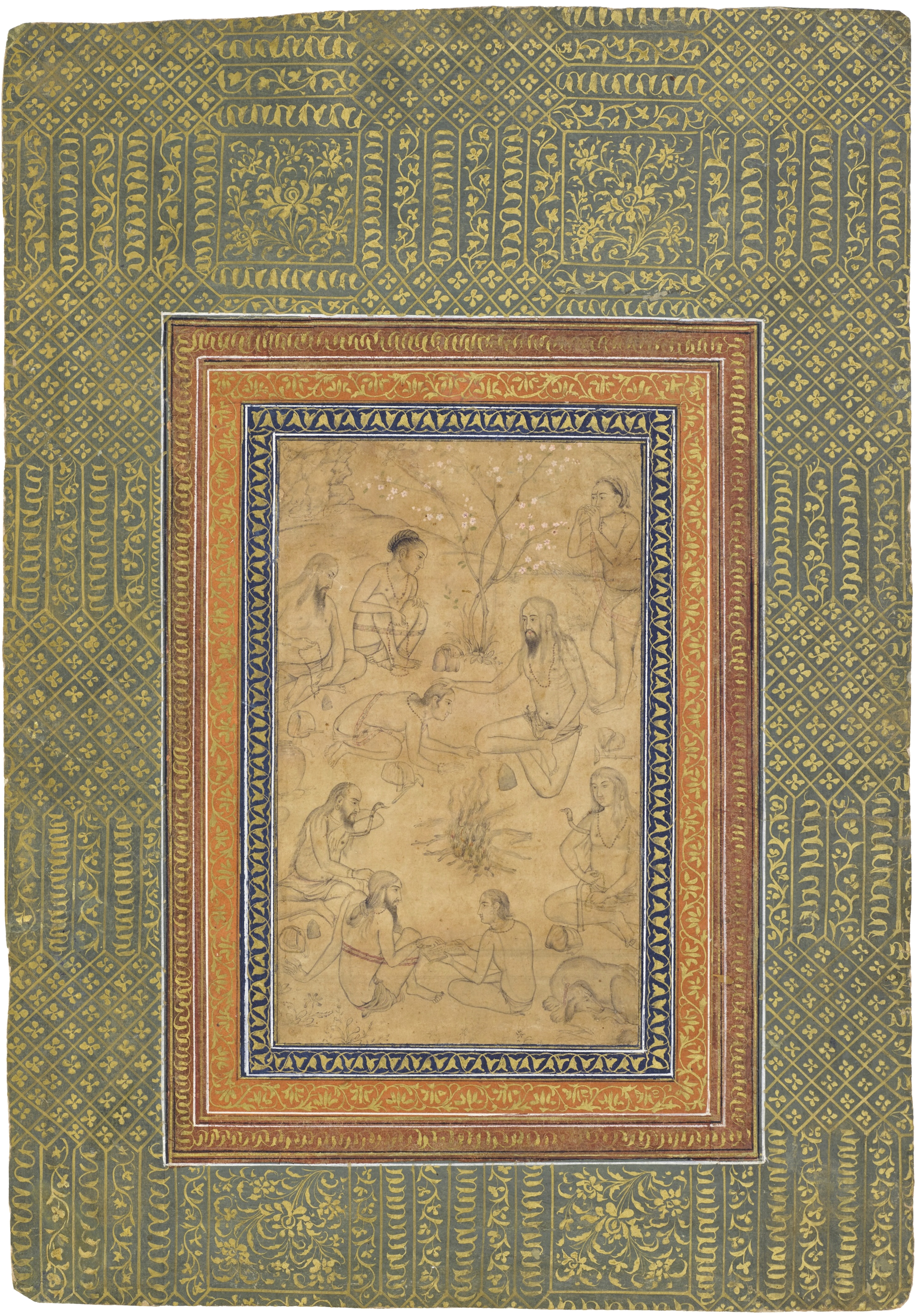
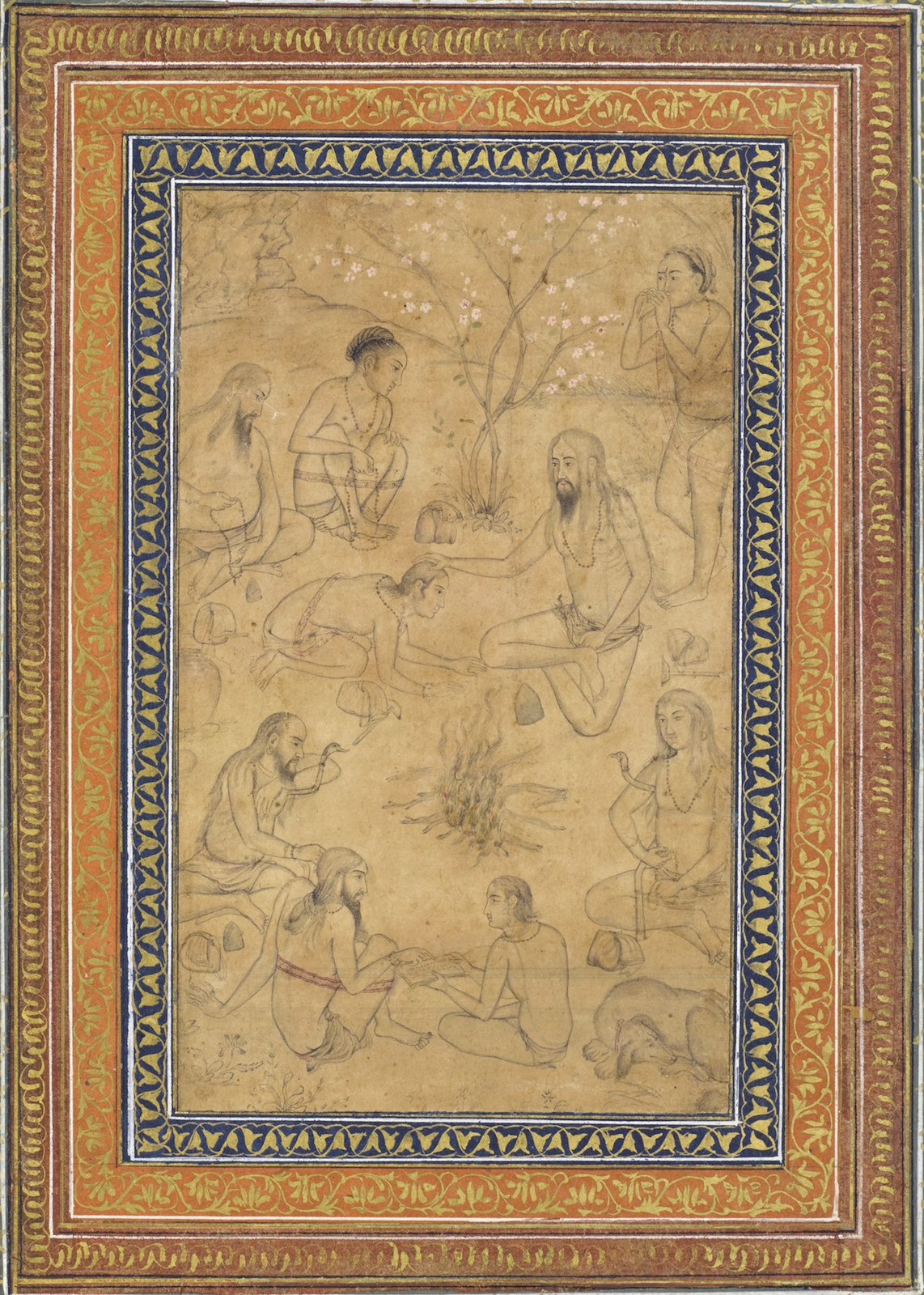
A group of yogis of varying ages is gathered round a fire. An almond tree with white blossoms presides over the gathering. Our attention is drawn to the foreground pair, younger and older, who are examining a Hindu manuscript together and a similar pair in the middle ground where the younger one is crouching before the elder, who places his hand on the younger one’s head. Other yogis sit by themselves, some with yogapattas round their knees to assist in keeping their posture, or leaning on fakir’s crutches with snake handles, telling their beads, and meditating. Only one is moving, as he comes in blowing his conch. All are naked apart from a brief loincloth.
One bearded yogi seated in the foreground is resting on one hand allowing us to see the extra-long fingernails he has on that hand. Some wear necklaces of beads, others have bead rosaries, and various ears are adorned with different kinds of earrings. None, however, has the large wooden earrings or the horn suspended on a necklace associated with the Nath yogis, nor sectarian marks on the forehead, so their precise affiliation is unknown.
Drawings of groups of yogis formed something of a sub-genre in Mughal art in the earlier 17th century, perhaps because of Jahangir’s well-known fascination with them and with the ascetic Jadrup in particular. Pictures of yogis were especially useful for Mughal artists since their nakedness could be used as an exercise in modelling the volumes of the human body. Our drawing is close to an earlier drawing by the artist Shankar from the end of Akbar’s reign, that likewise shows yogis engaged in the study of texts (Galloway 2008, no. 4). For other drawings of yogis collected by Richard Johnson in the 1780s now in the British Library see Falk and Archer 1981, nos. 25-27, 45-46, 145; and for those from the Welch collection now at Harvard see Welch and Masteller 2004, nos. 19, 22, 29. One from around 1600, ascribed improbably to the dead Daswant, had reached the Royal Library, Windsor Castle, by 1728 (Hannam 2018, no. 4). For an especially-useful study of yogis in Mughal art see James Mallinson, ‘Yogis in Mughal India,’ in Yoga: The Art of Transformation, ed. by Debra Diamond, Smithsonian Books, 2013.
J.P. Losty