Provenance:
European Private Collection
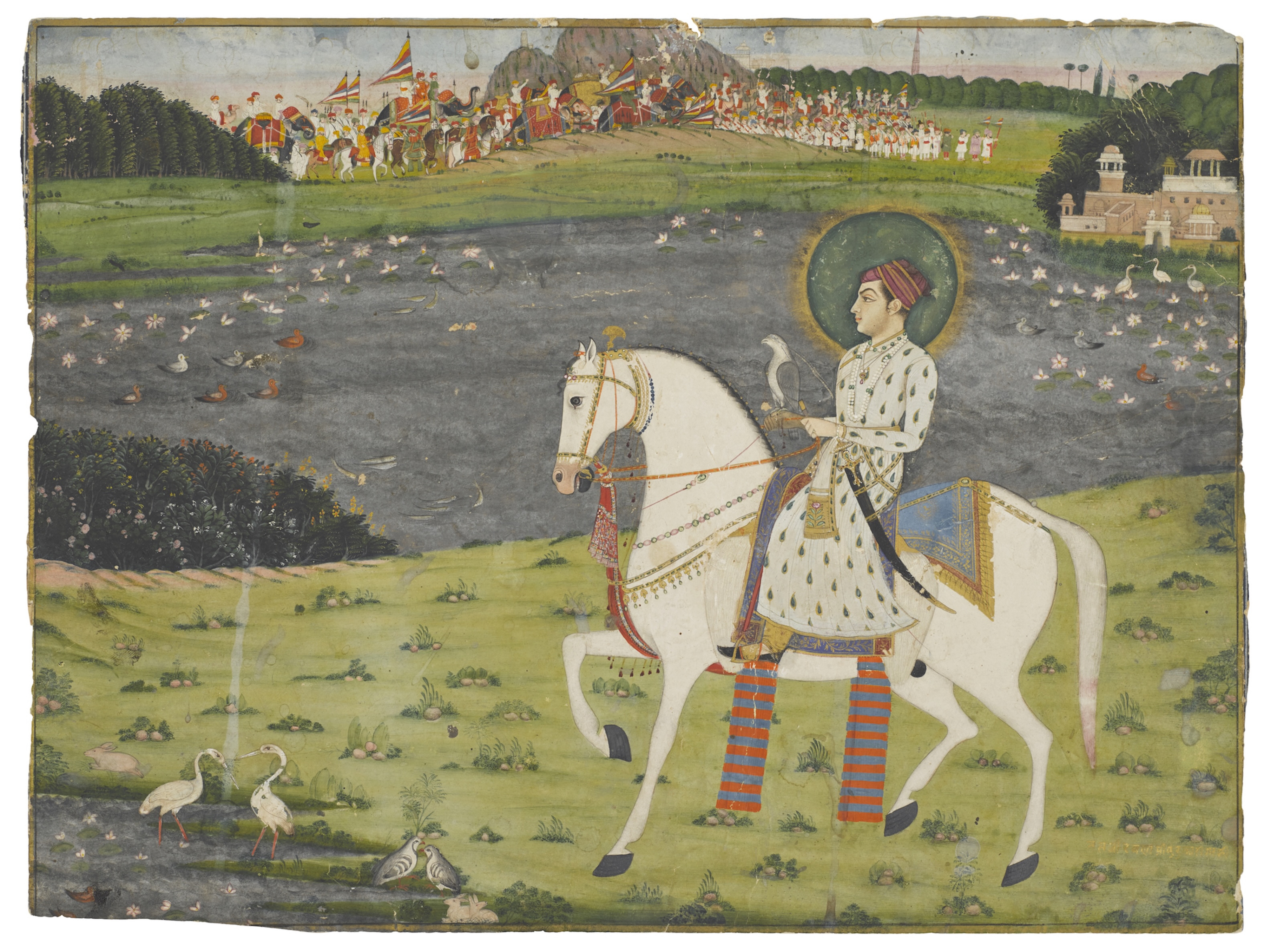
A young prince dressed in a long white jama patterned with green leaves outlined in gold is riding past a lake filled with lotuses and ducks. He is going hawking and holds a falcon on his gloved right hand while a tulwar hangs from a harness on his left side. A green nimbus and golden aureole encircle his head. The grey stallion is beautifully caparisoned with neck and shoulder chains and blue and gold saddle cloths, while chauris and long streamers striped in blue and red hang from the saddle. A Kashmir shawl is used as a martingale.
The greensward on which the prince rides is dotted with little rocks and clumps of vegetation. A small lotus pool with egrets, partridges, and rabbits is in the foreground. A large lotus lake with numerous water fowl runs right across the center of the picture. Beyond the lake rides a cavalcade of horsemen and elephants preceded by soldiers carrying muskets over their shoulder and some carrying pennants. A few Europeans may be identified by their black hats. Woods and a great rock dot the ground on this far side while in the distance is a tall tower. A pavilion looking rather like the Jai Mahal in the Man Sagar between Jaipur and Amber fort is on the far side of the lake.
The somewhat strange artistic attribution on the recto has not yielded any other works assigned to this artist, and he is not found among the Jaipur artists listed by Asok Das (1995) or Aitken (2011). The procession of an army in the distance had become something of cliché in 18th-century Mughal painting of the Muhammad Shah period—and its derivatives in Lucknow and Murshidabad—in order to demonstrate the artist’s command of spatial recession. Although naturally painted very small, the figures in our procession do seem to have turbans which can be associated with those worn in Jaipur in the mid-18th century with upward-sweeping back projections. A Jaipur processional scene from around 1750 also shows soldiers wearing these sorts of turbans (Pratap 1996, pl. VIII), some carrying striped colored pennants of the same kind as are being carried in our painting. This seems to be an allusion to the standards or pennants carried by the Maharajas of Amber/Jaipur, the Pancharanga, a pennant of five colored bands one above the other, although our pennants seem to have seven bands, the red and yellow being repeated. A lion hunt from around 1750 shows the same kind of landscape (ibid., fig. 13). The whole composition as well as the rows of trees still striving for some naturalism, before Jaipur trees reverted to hard edged conventionality, would seem to be derived from the Mughal artists whom Sawai Jai Singh invited to Amber, as indeed is the whole composition (see Das 1995 ‘Aurangzeb,’ pp. 71-72). The prince’s high arched eyebrow over a modelled eye is typical of the work of the Mughal portraitists in the first half of the 18th century. The previous owner, who attributed the painting to Bhavani Das on the verso, was not far off the mark in discerning the influence of Mughal artists on Rajasthani court painting in the first half of the 18thcentury, as in, for instance, Bhavani Das’s portrait of Raja Sahas Mal of Kishangarh with its lake and miniscule army in procession in the distance (see Haidar 2011, fig. 9a).
The identity of the prince is not clear, although it could be meant to depict, perhaps, Maharaja Ishvari Singh of Jaipur (1743-50), of whom few portraits survive, although those that do (two unpublished drawings in the Victoria and Albert Museum, for example) show him as rather stout. He was about 20 years old when he ascended the throne. His reign was marked by a struggle with his younger brother Madho Singh trying to oust him, since the latter, as the son of a Mewari princess, had been promised the throne in his mother’s marriage settlement. Ishvari Singh commemorated his victory over his brother in 1748 by building a tall tower in Jaipur, the Ishvari Lat, perhaps to be seen in the distance here. He committed suicide after Madho Singh’s forces defeated his in 1750.
J.P. Losty