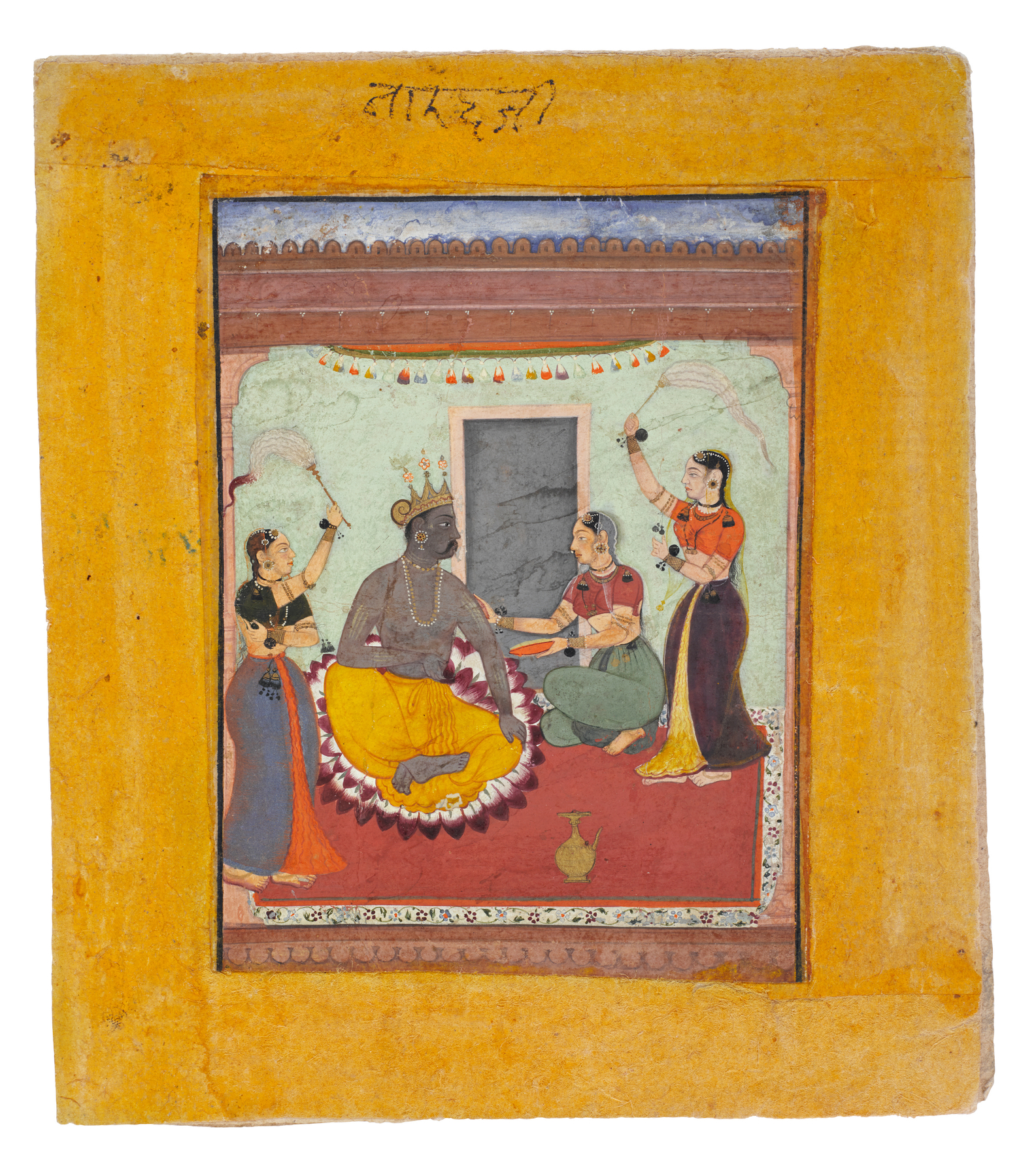
Inscribed in Devanagari above Naradaji and on the verso in an early hand (partly obscured by paper strengthenings) Gopiram Nabab Tijaghar ...96 (crossed out and replaced by 95)
Provenance:
European Private Collection, acquired in 1992
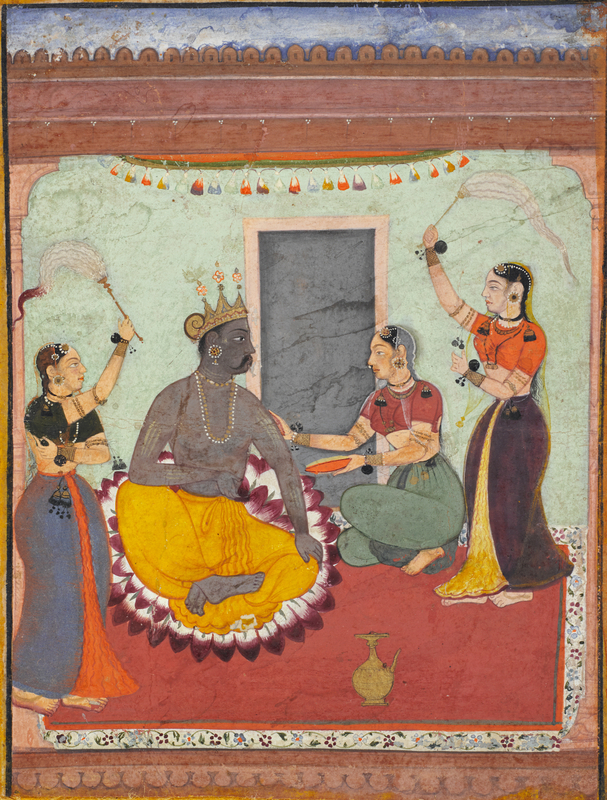
A dark-skinned divine being, moustached, crowned, and wearing a saffron dhoti, is seated on a lotus seat being tended by women. Two wave chowries over him, and a third crouches beside him, anointing his arm with a sandalwood paste. The women are dressed in Rajput costume of skirt, bodice, and diaphanous dupatta.
The scene is set on the verandah of a red sandstone building. They are seated on a plain red carpet edged by a white border with floral arabesque. Two pink sandstone columns uphold the roof of the verandah, while the green back wall is blank apart from a dark central opening. A cloudy blue sky is visible above the parapet.
The divine sage Narada, the musician of the gods, and sometimes one of the minor avatars of Vishnu, is invariably pictured with the instrument normally inseparable from him, his vina. So to see a divine being who purports to be him without it must make the inscription above, of indeterminate date, somewhat doubtful. It could be either Rama or Krishna in their maturity. The comparatively-early inscription on the verso is of no help in this regard, although it does identify one Nawab Gopiram and a possible place Tijaghar, which may be the same as the Tijara some 30 miles north-east of Alwar. This was a sarkar or subdivision of the subah of Delhi under Akbar and Jahangir and one of the chief places of the Khanzadas of the Mewatis. It only became part of the Alwar state in 1805. Of course such an inscription does not indicate necessarily that the painting was done there, and in fact there are other stylistic traits to consider.
The style of our painting is the simplified Mughal style found in Rajasthan and elsewhere 1580-1620, formerly known to scholars as Popular Mughal. Key documents of this style are the dispersed Ramayana of 1595-1605, the Manley Ragamala in the British Museum, and the Laud Ragamala in the Bodleian Library, all of them under Hindu patronage from one or other of the Rajput courts. It is to be distinguished from Sub-imperial Mughal, which is a term best applied to manuscripts and paintings under Muslim patrons such as the Khan-i Khanan, ‘Abd al-Rahim. See Seyller 1999, ch. 1, for an analysis of these more popular Mughal styles.
The dispersed Ramayana series of 1595-1605 is, in fact, the only one of these series which has a possible provenance. Many of its pages have a stamp from the Datia palace collection in Bundelkhand as well as inscriptions in the Bundeli dialect of Hindi, and its patron is thought to Raja Bir Singh Deo of Orccha (Seyller in Mason 2001, p. 62). Bir Singh Deo was a great friend of Jahangir when still prince Salim, and he rose to great wealth and power when Jahangir was emperor and became a major patron of architecture. Several different artists are associated with the Ramayana series, some of whom possibly, as Seyller suggests, had just left the Mughal atelier, but the work of others has a much more Rajput appearance. One of the artists, in particular, likes to display his well-drawn and modelled figures in front of the most gorgeous decorative designs of panels or fantastic architecture, totally eschewing the spatial conventions of Mughal painting (Goswamy and Bhatia 1999, no. 36; Mason 2001, no. 16; Topsfield ed. 2004, nos. 157, 157, 162; Topsfield 2012, no. 8).
No paintings have been associated with the Bundela court later in Bir Singh’s reign, but this painting has some traits which suggest kinship with the Ramayana series, in particular in the representation of females. Square heads and Rajput costume are common to all these early Rajput styles, but the particular profile of the females in our painting, the curves of forehead and hair, the configuration of nose and chin, the diaphanous orhnis worn towards the back of the head but falling over the ear and without a gold border, as well as their ornaments—large circular earrings ringed with pearls, matched by some jeweled circular ornaments on the front of the hair, as well as sometimes double armlets—suggest some influence from this artist of the Ramayana pages. Narada’s square head and determined expression, his eye, and his triple-peaked crown with lotus finials, and the curves of its upturned back projection also have parallels in some of the pages by this same artist in his depictions of Rama and Dasharatha.
J.P. Losty